How does corn show up on your Thanksgiving plate?
Turkey
Turkeys eat lots of different foods. 30-40% of all corn grown in Kentucky goes toward livestock feed, including turkeys! They munch on corn, seeds, berries, nuts, leaves, and small creatures such as insects. How much corn does a DOMESTIC turkey eat?
- For a 20-pound live-weight turkey, a rough estimate is about 40 pounds of corn—as part of a balanced feed, not fed by itself.
- USDA estimates turkey feed conversion at about 2.95 pounds of feed per pound of live weight, with corn making up about 70% of the ration. That works out to roughly 41 pounds of corn (20 × 2.95 × 0.70). Actual amounts vary by the bird and how it’s raised.
- A turkey doesn’t eat only corn. Its feed includes other ingredients, such as soybean meal, to provide the nutrients it needs to grow.
Sweet corn
People began domesticating teosinte plants over 9,000 years ago in southern Mexico which was a part of Mesoamerica. Teosinte looked very different than the corn we see today. The ear on the teosinte plant was small and its kernels were very hard and difficult to eat. The plant was mostly used for their husks to make items such as baskets, sleeping mats and clothes.
Over the years, the teosinte plant was adapted to grow in different environments and to produce bigger ears with edible kernels. The grain developed into what is now known as corn, also called maize. Corn became widespread as the native people became nomadic, traveling and trading both to the south through Central America and to the north through Mexico into what is now the United States. Corn was very important to the Mayan and Aztec civilizations and to the native Americans. Archaeologists have found corn in the southwestern region of the United States dating back to 5,000 years ago.
Cornbread
Cornbread is made with corn meal, which is dried field corn that has been ground into a range of textures such as fine, medium, and coarse. That corn meal is then mixed with other ingredients such as wheat flour, lard, eggs, and sugar. Not only is corn used directly to make cornbread in the corn meal, but corn also plays a role in producing eggs and lard!
A large portion of corn grown in Kentucky goes toward feeding chickens and pigs in the state, with over 50 million bushels of corn in 2025 going toward those two industries.
Corn at the first Thanksgiving: The History of Corn at Thanksgiving
Sweet corn actually wasn’t served at the first Thanksgiving meal, despite the Thanksgiving staple it has turned into today. Sweet corn was first grown in the U.S. in 1779. That was 158 years after the first Thanksgiving meal!
The corn served at the first Thanksgiving meal was flint corn. The kernels were hard and dried, so they ground them into a cornmeal and used to make food like flat unleavened bread.
The Wampanoag people were skilled farmers who grew three important crops known as the “Three Sisters”: corn, beans, and squash. These crops were an important part of their everyday diet. Although these foods were common in the region, historians do not know exactly what was served at the 1621 gathering. Historical records mention foods such as deer, birds, fish, eels, shellfish, stews, and vegetables.
Types of Corn:
Corn, also called maize, comes in four main varieties. All four types grow on similar-looking plants, but their kernels have different traits. A kernel is a seed: it has a tiny baby plant inside and stored food to help it grow. Farmers grow different kinds of corn for different purposes.
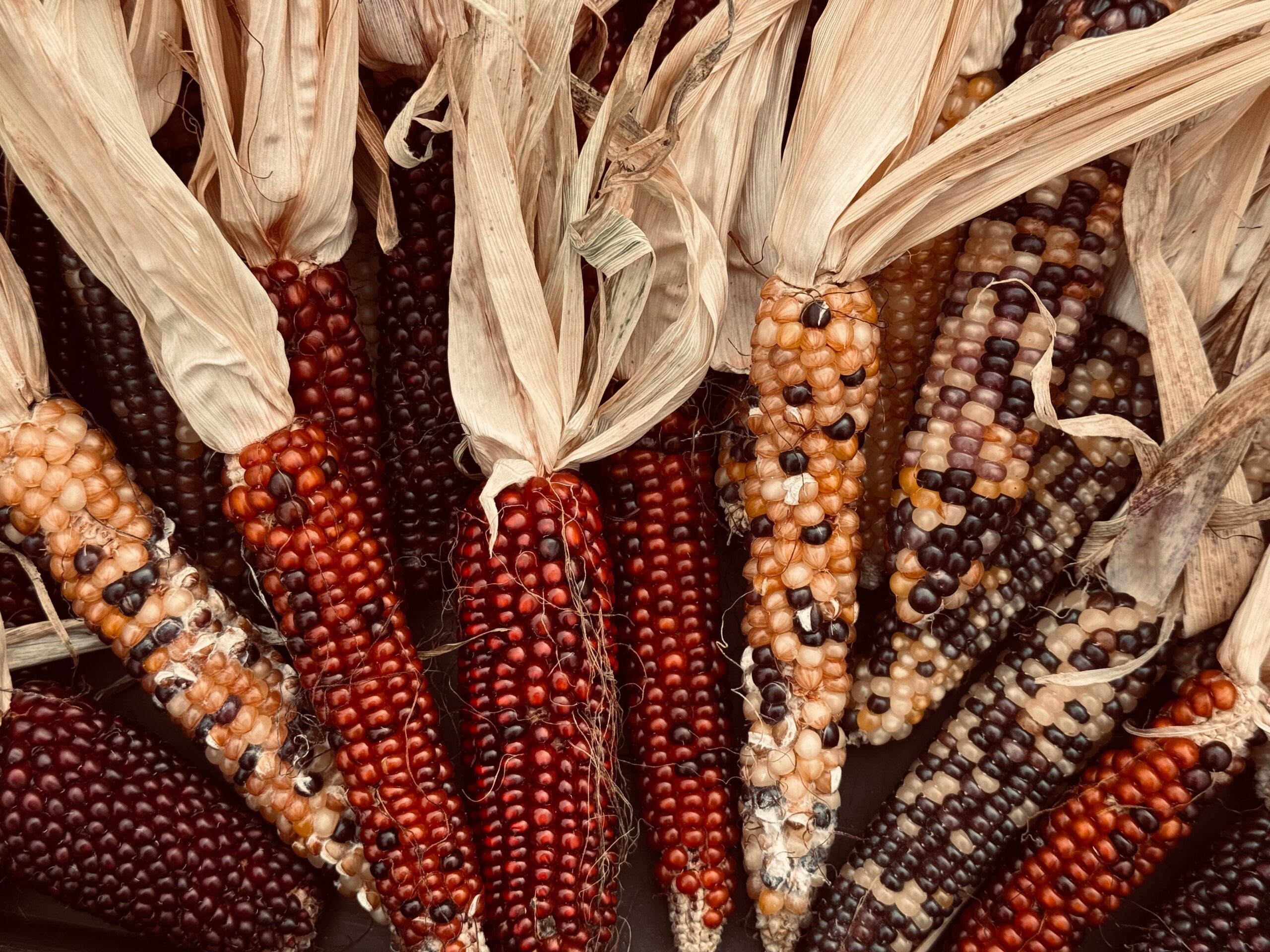
- Flint corn-hard and colorful corn
- Flint corn has a very hard outer part around its starchy center. Its kernels can be many colors, and some colorful varieties are sold as autumn decorations. Flint corn can also be ground or prepared as food; it is not just for decoration.
- Ask students: What colors and patterns can you spot on an ear of flint corn?
- Sweet corn- the kind we eat fresh
- Sweet corn was developed around the year 1646 and has more natural sugar than dent corn, so it tastes sweet. People eat it on the cob or use it canned or frozen. Farmers usually pick it while the kernels are still soft and juicy.
- Ask students: What foods have you eaten that are made from sweet corn?
- Dent corn- also called “field corn”
- Dent corn gets its name from the small dip, or dent, that appears on top of each kernel as it dries. It is often harvested when the kernels are dry. Farmers use it for animal feed and to make foods and products—including some corn-based fuel, such as ethanol.
- Ask students: Why might a farmer grow corn for animals or fuel, not just for people to eat?
- Popcorn- the corn that pops
- Popcorn kernels have a tough outer shell and a starchy center. A little water inside the kernel turns to steam when heated. The steam builds pressure until the kernel pops and turns inside out.
- Ask students: What do you think would happen if a popcorn kernel had a crack in its shell?
Educational Thanksgiving Corn Resources
We are excited to offer an activity sheet for the Thanksgiving holiday. The “Thankful for Corn Farmers” activity sheet helps students make the connection between agriculture and their Thanksgiving meal. Students can help the turkey find its meal, complete a word search focused on products made from corn, and solve a math problem to learn that sweet corn would not have been on the plate at the first Thanksgiving. Download the activity sheet below. Be sure to use the teacher guide to add additional learning as the students complete the activities.
KY Corn, through partnerships with the National Corn Growers Association and Kansas Corn, help supports the National Corn STEM program, which provides agriculture education materials nationwide for K-12 grade levels.