
Payment Rules, 2026 Enrollment, and Factors to Consider
Read time: 7 minutes
The United States Department of Agriculture (USDA) has opened enrollment for the Agriculture Risk Coverage (ARC) and Price Loss Coverage (PLC) farm safety net programs for the 2026 crop marketing year, with the 2027 enrollment period not far behind. Producers will have to choose which program is best for their base acres.
The programs use different parameters to determine payments, and those parameters can create big payment discrepancies based on which program you enroll in.
Bridget Yeboah Bafowaa, Ph.D. student in the Department of Agricultural Economics and Rural Sociology at Auburn University, conducted on analysis of ARC and PLC payment outcomes at the county level using payment data from the 2025 year to demonstrate the potential financial implications this choice can have.
“PLC is designed to stabilize income from low prices, while ARC covers revenue shortfalls from a combination of low prices and/or low yields,” Bafowaa said in her article.
Deciding between the two programs can be difficult, since there’s no surefire way to predict market conditions and crop outcomes. Depending on the situation, the PLC payment could be higher one year, and the ARC payment could be higher the next.
It’s important to understand the factors that affect the payment rates for each program, so you can make an informed decision for your operation. While no one can predict the future, you can understand these programs to the best of your ability and base your decision on what you know of your own operation.
Enrollment Deadline Dates:
- 2026 crop year ARC/PLC enrollment deadline: Now – December 11, 2026
- 2027 crop year ARC/PLC enrollment deadline: November 2, 2026 – March 15, 2027
What’s the difference between ARC and PLC?
“While ARC payments for a covered commodity are the same for all producers in a county, PLC varies based on an individual producer’s PLC yield,” Bafowaa said.
“PLC provides price support and triggers payments when the marketing year average price (MYA) falls below the effective reference price. Conversely, ARC provides revenue support and triggers when revenue falls below a guaranteed revenue level, with revenue determined by county yield (and not individual yield for ARC-County) and MYA prices.”
Changes to ARC and PLC for 2026
The One Big Beautiful Bill Act of 2025 (OBBBA) made changes to ARC and PLC during the 2025 marketing year, which allowed growers to receive the higher payment of the two programs for 2025, regardless of their original choice.
That will not be the case moving forward. Producers must make a choice for their base acres, and the parameters laid out by OBBA will last from the 2026 through the 2031 marketing years.
Early this month, USDA announced a record payment for ARC and PLC programs for the 2025 crop year, nearly $13.8 billion in gross payments to eligible producers.
According to USDA data, 2025 corn gross expected payments for Kentucky, before sequestration and payment limits are applied, total at $150,212,388.56.
2025 ARC vs. PLC payments: Which program paid more?
Since farmers will have to choose between the two programs from now on, reviewing payment data from 2025 can shed light on which program paid more in the past. Markets and prices are always unpredictable and will change how payments turn out in the future, but an analysis of 2025 payment outcomes can be one part of your journey to a more informed decision for your ARC vs. PLC choices.
For corn and soybeans in Kentucky specifically, Bafowaa’s analysis showed that the ARC program generated a higher payment per base acre more often than PLC for the 2025 crop year. This also matched the analysis’ trends at the national level.
“For corn and soybeans, the majority of the counties where base acres exist are receiving a higher payment rate under the ARC program,” Bafowaa said.
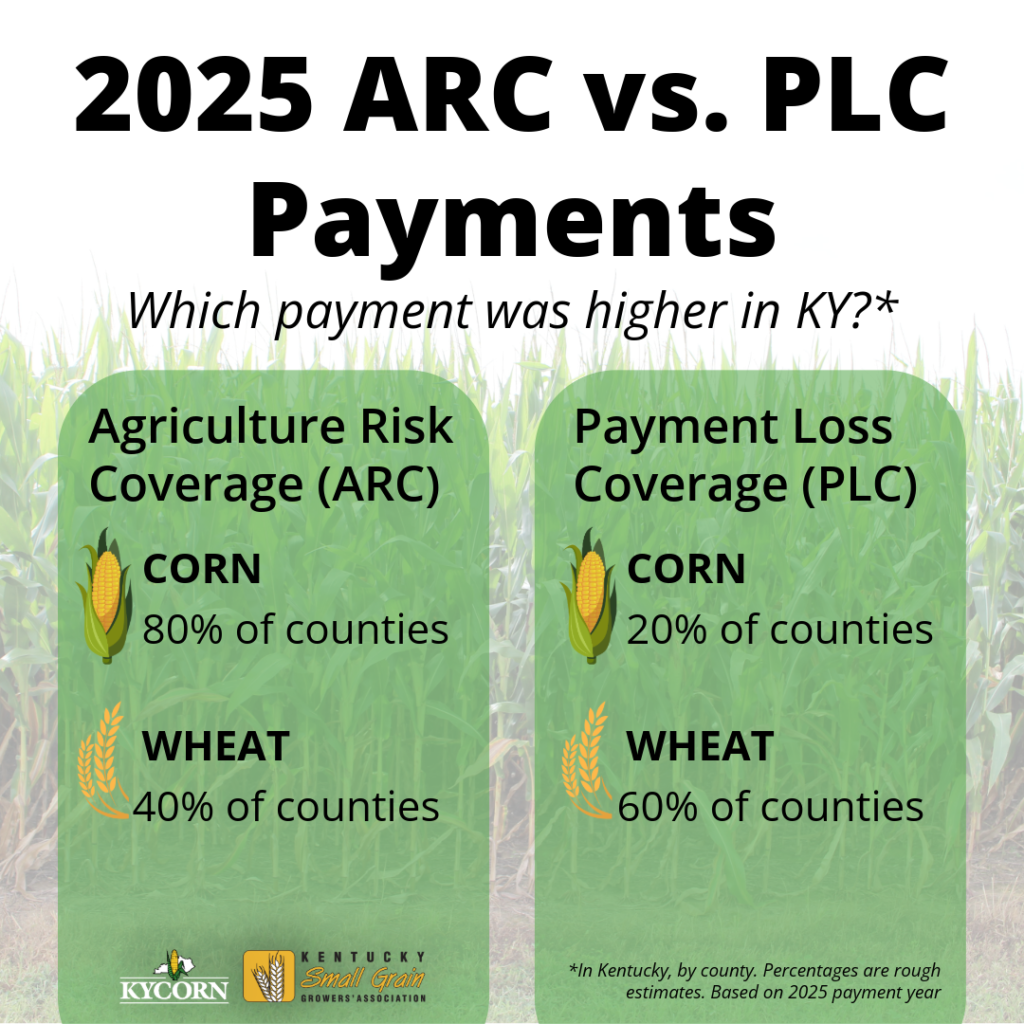
ARC provided the higher payment rate for corn in nearly 80% of counties in Kentucky with base acres, and over 90% of counties for soybeans.
A handful of counties in eastern and central Kentucky received a higher payment from PLC for corn, but the higher corn payment rate for all counties in western Kentucky came from ARC.
Wheat is a different story. In Kentucky, the higher payment for wheat came from a mix of the two programs, depending on your county.
Roughly 60% of Kentucky counties with wheat base acres received a higher payment rate from PLC, while roughly 40% of counties received a higher payment rate from ARC for wheat.
You can find Bafowaa’s map with the specific county data for the 2025 ARC vs. PLC payment breakdown for Kentucky here.
The difference between the ARC vs. PLC payments varied widely for 2025. The difference between the payment for the two programs could be as low as $5 per base acre, or as high as $350, according to Bafowaa’s article. Most commonly (nearly 60% of the payment differences), the difference was less than $44.30 per base acre.
“This means that if producers had to make a choice in 2025 under the new [OBBBA] provisions AND they made a choice that did not maximize payments, the payment difference would have been over $44 per base acre over 40% of the time,” Bafowaa said.
How do I choose between ARC and PLC?
The decision between ARC and PLC depends on your judgement and understanding of the payment triggers for each program.
Here’s what Bafowaa had to say:
“…if producers expect prices to decline while yield remains stable, PLC might be the optimal choice if prices are expected to be low enough to trigger a payment. If a decline in county yields is expected, particularly when accompanied by lower prices, ARC may provide a higher payment. In addition to using a decision guide, producers should consider both their price and yield expectations and the information that is available to them for the crop year when evaluating which programs may provide a greater farm safety net.”
It’s also important to remember that PLC varies based on an individual producer’s yield, while ARC payments for covered commodities are the same for all producers in a county.
Final Thoughts
Producers have until December 11, 2026 to enroll their base acres in ARC or PLC for the 2026 crop year. The enrollment period for the 2027 crop year also begins this fall, opening on November 2, 2026 and ending on March 15, 2027.
There are many tools available to help you make your decision before enrollment closes, including this analysis of 2025 payment data and the resources available below. There’s no way to guarantee maximum payments from these farm safety net programs, but taking the time to make an informed decision is worth the effort.
Further Reading
You can read Bafowaa’s full article here for the breakdown of her analysis and more fine details on the complexities of these two farm safety net programs.
Check out Texas A&M’s decision aid tool here to compare 2026 expected ARC and PLC payments for your different farms and crops based on 500 simulated scenarios of market prices and county yields.
Projected 2025 PLC payment rates can be found here. The final national PLC payment rate for corn is .26 per bushel.
The Farm Service Agency (FSA) has also released a downloadable, sortable Excel file of the 2025 ARC payment rates for all counties and states by crop.
Definitions of Essential Terms
ARC – Agriculture Risk Coverage program, administered by FSA
PLC – Price Loss Coverage program, administered by FSA
Statutory reference price – A fixed minimum price for covered commodities, set by law most recently in the One Big Beautiful Bill Act of 2025.*
Market year average (MYA) price – Reflects the average price received by farmers across the nation at the point of first sale, across all grades and qualities of the crop.* USDA publishes MYA price projections in the monthly World Agricultural Supply and Demand Estimates report.
Effective reference price – The effective reference price is the greater of the statutory reference price or 88 percent of the average of the Market Year Average (MYA) price from the preceding 5 years, excluding the highest and lowest prices, capped at 115 percent of the statutory reference price.*
Effective price – For the specific covered commodity, the higher of the market year average price or the national average loan rate.*